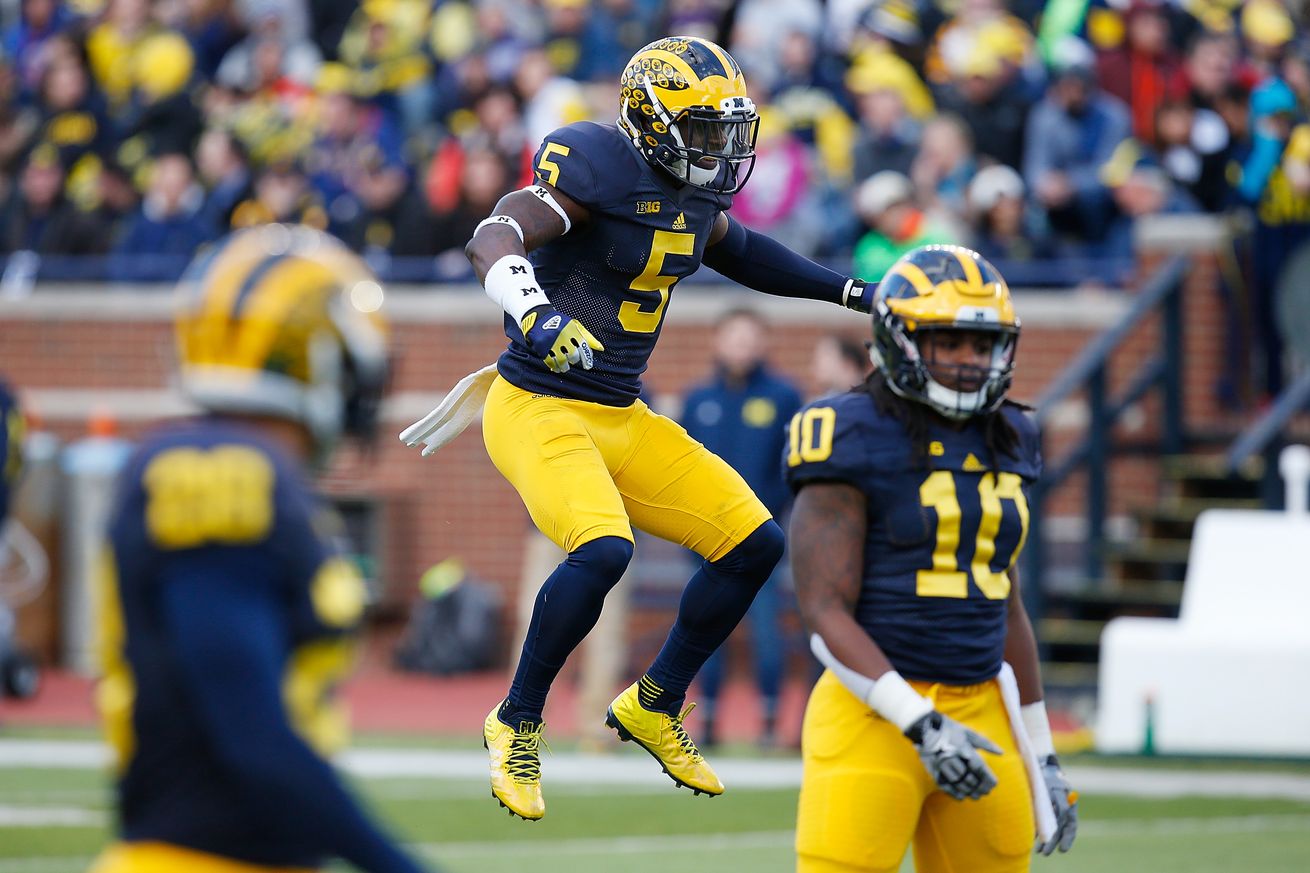
MLive’s Michigan football beat writer joins for our first football preview.
MLive beat writer Nick Baumgardner joins this episode for the first of our football previews. Listen live using the player below!

MLive’s Michigan football beat writer joins for our first football preview.
MLive beat writer Nick Baumgardner joins this episode for the first of our football previews. Listen live using the player below!
 Logan Bowles-USA TODAY Sports
Morris enters his senior season as the veteran leader of a young group of running backs.
Name: George Morris
Position: Running Back
Year: Redshirt Senior
Height: 6’0″
Weight: 182
Hometown: Lawrenceville, GA
High School: Central Gwinnett
2015 Stats: Morris played in all 12 games during his junior season for the Syracuse Orange, finishing third on the team in rushing with 326 yards on 66 carries. He started the season behind the now-departed Devante McFarlane on the depth chart, but they both got eclipsed by then-freshman Jordan Fredericks for carries as the season progressed.
2016 Projections: Continuing to be surpassed by younger talent, Morris was listed fourth on the post-spring depth chart at running back behind sophomore Dontae Strickland, sophomore Jordan Fredericks and freshman Moe Neal. Morris is facing the prospect of decreased playing time in his final season in Orange.
How’d He Get Here: Morris chose SU over offers from a trio of Big 10 schools (Illinois, Indiana, Purdue), Utah, Vanderbilt, Memphis and a few others.
What’d Recruiting Sites Say?: He was rated three stars across the board coming out of high school.
Money Quote: Here’s what Morris had to say after the Clemson game last year when asked if it is difficult or frustrating to have to sit behind younger players and wait to make an impact:
“It was kind of difficult, but, at the same time, you’ve got to think of the bigger picture. And that’s the team, and you gotta make sacrifices. I had to make a sacrifice, and I was willing to do it.”
Links of Wonder: By all accounts, George Morris is a team-first player who takes his opportunities when they present themselves, as highlighted by this Daily Orange article on him from last year after the Clemson game. Morris seems to have the right attitude to help lead a young group of running backs during his senior season, even if it’s in a backup role.
Twitterfeed: @GMII27
Tweets of Wonder: George likes to get philosophical on his Twitter feed.
At some point you have to let go of what you thought would happen and live in what is happening.
— George Ⓜ️orris II (@GMII27) June 10, 2016
What Does the Coaching Staff Think of Him?: Being listed fourth on the depth chart, including behind an incoming freshman, certainly speaks volumes. Morris has played a significant role on special teams in the past as a kickoff returner, but Brisly Estime was the only player listed as a kick returner/punt returner on the post-spring depth chart. It will be interesting to see what kind of on-field role he plays this year.
Interesting Nugget O’Interest: Morris pulled the switcheroo on Syracuse fans a few years ago when his name seemingly changed from ‘George Morris III’ to ‘George Morris II’.
Let’s Get a Good Look Atcha:
The No. 1 Florida State football podcast tackles five questions on fall camp.
Bud Elliott and Ingram Smith return with an episode of The Nolecast. Florida State fall camp begins August 9, so they get into a few topics.
Quick topics: Spurrier at UF, Social media and coaching rules, and Cam Akers.
Smith and Elliott try to focus only on questions that can actually be answered during fall camp, as opposed to broader questions about the season.
Bonus: Who fills the special teams roles?
 Brendan Maloney-USA TODAY Sports
Jett Duffey’s character and leadership qualities should excite Red Raider fans for the future. It was profiled last year on the biggest stage if you missed it.
For most college football teams the quarterback is the leader, both on and off the field. They get the most attention and the most scrutiny, deserved or undeserved. Their success usually translates into team success.
For the 2016 season, I think we can all agree that this is Patrick Mahomes’ team. He is the leader, both in the huddle and on the sideline, for these Red Raiders. With the experience he has, his teammates listen to him and follow him wherever he takes us. He has two years left (assuming he comes back for his senior year). That’s when our future leader will step right in, making sure we don’t miss a beat.
I love the Elite 11. With the 2016 series recently being released (and binge-watching the this weekend), it reminded me of last year’s episodes. In the first episode, the first invitee profiled was Jett Duffey.
If you didn’t see it, check it out here. Watch the whole thing because it is amazing, or start at 3:50 to skip to Jett’s piece.
I would go to war with that guy. He’s obviously an incredibly talented quarterback, but the competitive nature and work ethic he has is going transform him into the future leader of Texas Tech football. Add those characteristics with the weight he has already put on with Coach Whitt and the skills he’s learning with Coach Kingsbury and we have a quarterback that is going to follow Mahomes nicely.
Jett is a baller. And the fact that Kliff loves him only instills more confidence. I am 100 percent certain there isn’t a better evaluator of QB talent than Kliff Kingsbury.
Patrick Mahomes had one power five offer. Jett Duffey had one power five offer. Good with me.
 Jim Brown-USA TODAY Sports
C.J. Duncan returns from injury to join a receiving corps that could use the help.
If you want an idea of what kind of offense Derek Mason and Andy Ludwig are going to run, here are some key numbers as Mason enters his third season as head coach.
Vanderbilt has eight scholarship wide receivers on the roster. The Commodores also have six tight ends, and seven running backs (including fullbacks.) And one of those “receivers” is Darrius Sims, who frequently lines up in the backfield.
In other words: Mason and company aren’t planning to run a lot of three- and four-receiver sets. Two-receiver sets with a tight end or two and/or a fullback are going to be the norm from here on out.
The Commodores ranked 108th in Passing S&P+ in 2015 and while much of that had to do with inconsistency at the quarterback position, the receivers weren’t helping a lot, either. C.J. Duncan missed the season after catching 28 balls for 441 yards as a sophomore. Latevius Rayford began the season as a starter after being Vanderbilt’s most-targeted receiver in 2014 with 61 targets; in 2015, he was only targeted 38 times and his catch rate dropped from 59.0% to 50.0%. (Again, some of this might have to do with quarterback play — but then it’s not as though Vanderbilt’s quarterback play in 2015 was worse than it was in 2014.) Departed senior Kris Kentera began the year as essentially a co-starter, but dropped down the depth chart while posting a catch rate of 38.9%.
In short — the receiving corps had issues in 2015. But the Commodores did have a couple of guys emerge from the pack.
Trent Sherfield: Look, I don’t like pulling the Austin Peay card again, either. But Sherfield’s numbers if you take out the AP game look pretty pedestrian: 35 catches for 419 yards. Sherfield showed some promise as the number one wide receiver as a sophomore, but disappeared at times; in a four-game stretch starting with the Houston game, Sherfield caught just four passes. (Yes, I’ll grant the point that Vanderbilt’s quarterbacks only completed 26 passes in that stretch. The point is a #1 WR should never be that quiet.) Sherfield did start every game, however, and he’s the best hope Vanderbilt has for having a threat in the passing game in 2016.
Caleb Scott: While Sherfield was the guy from day one in 2015, Scott didn’t work his way into the starting lineup until the Week 5 game at Middle Tennessee — but from there, he started all of the remaining games. While Sherfield led the team in raw receiving yards, Scott led the way both in catch rate and yards per catch — indicating that he was making the most of fewer targets.
Darrius Sims: He’s listed on the roster as a WR, but perhaps that’s a misnomer; in fact, Sims didn’t catch a single pass in the last five games of the season. But he did get 21 carries as a runner. Sims will return kicks and also line up as a running back or a wildcat QB. Still, he hasn’t “permanently” moved to RB and may still line up as a receiver from time to time, but using him as a full-time receiver isn’t the best use of his talents.
Latevius Rayford: To say Rayford’s junior season was a disappointment is the understatement of the year. As mentioned above, Rayford was Vanderbilt’s second-leading pass catcher in 2014, and he caught 7 passes for 57 yards and a touchdown in Week 2 against Georgia. And then he caught 11 passes for 92 yards… for the rest of the season. What happened? Well, for one thing, Rayford got overtaken by Caleb Scott, but Rayford’s 50 percent catch rate was also a problem. He’ll get some snaps on the rare occasions when Vanderbilt goes 3- or 4-wide, but he’s probably not getting his starting job back.
C.J. Duncan: Duncan had the second-most receiving yards on the team in 2014, albeit with a 50.9% catch rate, before missing all of 2015 due to injury. On paper, his return should help the receiving corps, but it’s not clear where he fits in. Both Trent Sherfield and Caleb Scott showed enough as starters in 2015 that you can’t just pencil Duncan in as a starter at WR. To be sure, he’ll be a factor in the passing game, it’s just not clear what his role will be.
Chandler Dorrell: After catching 10 passes for 118 yards as a redshirt freshman, Dorrell was targeted three times in 2015 when his father was not the team’s offensive coordinator.
Donaven Tennyson: Of the three freshman wide receivers, Tennyson probably has the best chance of making an immediate impact. He’s a burner, albeit a bit undersized at 5’10″/164. Tennyson could ultimately move into the Darrius Sims role down the road; for now, his speed gives him a chance at seeing the field in 3- and 4-receiver sets.
Jackson Winrow: Winrow was an underrecruited guy (Tulsa was his only other offer, if recruiting services are to be believed), which might be a function of playing high school ball in an underscouted area. He’s not a burner and only has decent size at 6’1″/182, but he has good hands on tape and could function well as a possession guy down the road. But he’ll probably redshirt in 2016.
Kalija Lipscomb: See what I just wrote about Winrow? I could write a lot of the same things about Lipscomb. On the other hand, Lipscomb does have a good ability to catch balls in traffic, which could make him useful down the road. But he enters his true freshman season pretty far down the depth chart, and like Winrow, he’s a redshirt candidate.
 Jared Wickerham/Getty Images
Pitt lands a local three-star offensive linemen.
I am proud to announce that I have committed to the University of Pittsburgh!! #H2P pic.twitter.com/FxnFZ1Imr6
— Gabe Houy (@GabeHouy) August 1, 2016
Pitt picked up a three-star offensive linemen earlier this evening. Gabe Houy of Upper St. Clair High School committed to play for his hometown school. Houy is a 6’6″ 270 pound offensive linemen. He chose Pitt over other power five offers from Louisville, Maryland, Illinois and Wake Forest. He is graded as a three star by both Rivals and 24/7.
Gabe Houy is now the 11th commitment for the 2017 recruiting class. He is now the second offensive line recruit, joining Owen Drexel of New Jersey. Houy is just the second recruit from the WPIAL, and only the third recruit from the state of Pennsylvania overall. Pitt has typically leaned heavy on their home state for talent in the past, but this staff has been able to find recruiting success out-of-state.
Gabe Houy will be reunited with his former high school teammate, Brandon Ford next season. Ford was also a three-star offensive linemen from Upper St. Clair. Houy will likely come into the program as a tackle given his 6’6″ 270 pound frame. He displays pretty good athleticism in his hudl video. He is only 270, but has the frame to add weight to play at this level.
I would expect recruiting to slow down a bit with the season rapidly approaching. Most kids will be focusing on their upcoming senior seasons, and will start using their official visits. Pitt had 8 commitments at this point last season, so with 11 they are slightly ahead of the game.
 Michael C. Johnson-USA TODAY Sports
John Davis is the latest addition to the 2017 class…
Euless Trinity cornerback John Davis announced via Twitter tonight that he is committing to Texas Tech as part of their 2017 recruiting class.
With Deeply Thinking This Through I Am Blessed To Say That I Have Committed to Texas Tech University! #GunsUp17 ⚫️ pic.twitter.com/whRnmXwlbM
— John Davis (@jdwavy) August 2, 2016
Davis is listed at 6’1″, which surely excites David Gibbs who will welcome more height in the defensive backfield to compete with taller receivers in the Big 12. As a three star recruit, Davis also held offers from Minnesota, Utah, and Kansas State among others.
Of the 13 recruits committed to Texas Tech for 2017, Davis is the fourth defensive back, highlighting an emphasis from the coaching staff to improve the defensive backfield. From his highlight tape on Hudl, it appears one of his strengths is being able to tackle in the open field, which could be an asset in helping Texas Tech improve their run defense beyond just bolstering the defensive line.
 Rick Diamond/Getty Images
Former Vanderbilt quarterback Jordan Rodgers is, apparently, the winning contestant on ABC’s The Bachelorette, which I can’t confirm for sure because I don’t watch that crap but you just know fans of other SEC schools are about to start telling you that this is Vanderbilt’s biggest win ever.
Except for the 2012 Music City Bowl win over NC State, and the 2012 win over Tennessee that mercifully euthanized Derek Dooley, I guess. Both of which also involved Jordan Rodgers.
I’m also being told Jordan proposed to “JoJo” on national television, which, sure, why not, that’s better than proposing on the jumbotron at Dudley Field I guess.
I can’t do this. No, I don’t care about The Bachelorette and neither should you. Here, just watch a damn highlight tape of him being Vanderbilt’s quarterback so we can all remind ourselves why I am writing a post about the damn Bachelorette.
Yeah, that’s it. All right, teenage girls who actually watched this, have at it in the comments.
That makes two defensive line commits for the 2018 class.
Defensive line coach Jackie Shipp scores another recruit along the defensive line.
Blessed to say that Im 100% committed to the University of Missouri #GoTigers @DemetricDWarren @samspiegs pic.twitter.com/qBim1t7DZa
— J.➰ (@lajoshhh) August 2, 2016
| Name | Josh Smith |
| Position | DE |
| Height, Weight | 6’4, 247 |
| City (School) | New Orleans, LA (Landry-Walker |
| Rating (Rivals) | NR |
| Rating (Scout) | NR |
| Rating (247 Composite) | NR |
| Other Offers of Note | — |
| Previous Posts | — |
We didn’t really have Smith on our radar and this commitment feels pretty out of the blue. Smith joins 2018 DL Daniel Parker who committed last Sunday.
You can check out the rest of our recruiting hot board below. Obviously we don’t have a very clear picture of the 2018 class but we do know some of the bigger names and attempted to slot them in.
Congrats and welcome to the Zou Josh!
Follow @RockMRecruiting for more updates

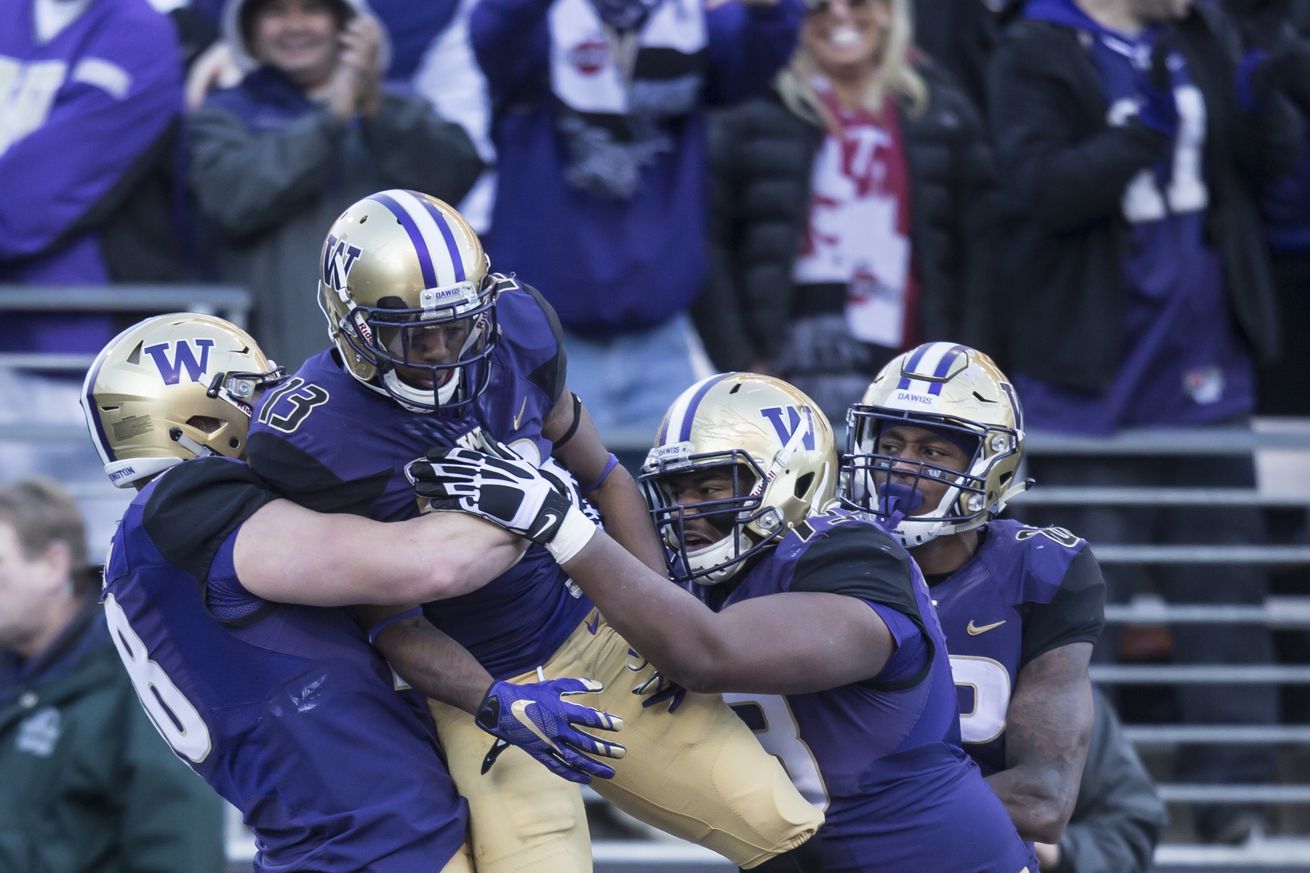
If the Huskies are to be serious contenders, they must run the ball consistently in 2016
Attention Husky football fans: this is the most important camp preview you will read. As far as DawgPound articles go, it won’t be the most well written (I’m not Chris Landon), it won’t be the quirkiest and most fun to read (I’m no Gabey Lucas) and it won’t take you on a high school joy ride with moments rivaling ‘Talladega Nights’ (I was never a rockstar teen like Ryan Priest). Still, this is a must-read because the running game is the single most important element of football. Yes, the game has become pass-happy. Yes, turnovers can decide outcomes. But if a team can line up, show run, give the ball to their running back and successfully move the chains, the offense will stay on the field. A good running attack makes things easier on the passing game and allows rest for your own defense. In short: Run the ball + stop the opponent from running the ball = win.
Defense versus the run is equally as important, but not nearly as important for the 2016 Huskies as the offense’s ability to establish a running game. Last season, UW was 9th in the Pac-12 conference in rushing offense with 163 yards per game and a 4.5 YPC average. Those numbers aren’t awful, but the 95 YPG and measly 3.02 yards per carry in the five games against defenses ranked in the S&P top 50 is pure crap and must improve if this team is to contend.
Every year around this time my dad will ask me “So, how do we look?” He’s a UW alum and season ticket holder since 1953; a huge fan obviously. That being said, he is 84 years old and has a hard time remembering that my name is John without thinking about it for a second, therefore he needs yearly (ok, daily) refreshers on the Huskies’ outlook. I will tell him about the QB situation, UW’s outstanding RB du jour, and the accenting defensive prowess. He’ll digest that info, nod as he processes it, then after a pause will inquire: “How is the offensive line?”
“Well, they return a lot of guys.” I offer up.
“Okay,” another pause. “Are they any good?”
The longest pause of all belongs to me; “No, Dad. They are not. They could be good.”
Therein lies the #1 point of concern for the Huskies in 2016. Prognosticators who have them winning the North or being a Top-10 team look at the roster and think that, since they are returning almost everyone from the two-deep on the offensive line, they must be good. No, not necessarily. They could be good. The running back is good. The defense is good. But the offensive line —looking at it with my purple shades in my pocket and the grape Kool-aid still in the fridge—is nothing better than mediocre. They were really young last season, and it was encouraging that they were able to have great success against lesser defenses (205 yards per game, 5.07 YPC against FBS teams outside the S&P top 50), so yeah, I’m ready to put on the shades and pour myself a tall glass of Kool-aid. But as opposed to a defense that returns experienced players from a statistically excellent group, the offensive line simply returns experienced players; some of the most promising ones with less than a full year of that. We can’t call them good until we see them play well against top defenses. If the Dawgs do put together a great offensive line, watch out.
The O-line is not singularly responsible for providing the blocking in the running game. Wide receivers and tight ends must interfere with the edge-setters at the line of scrimmage and provide the downfield blocks that turn 7-yard gains into huge, electrifying runs. Wide receiver blocking was not great for the Huskies last season. When a team uses three tight ends, as often as UW did —usually with at least one split as a WR— it says something about the physicality of the receivers. UW just hasn’t had a big-bodied blocking WR since Kasen Williams and Kevin Smith. Josh Perkins is the right size and was the player Chris Petersen tried to use in that capacity, but he couldn’t block corners. Darrell Daniels is a better blocker than Perkins, but too big to get a piece of DBs. Connor Griffin has shown himself to be an excellent blocker, has lightened himself 10 pounds, and hopefully for the Dawgs will be the answer here.
There is every reason to believe that Daniels, Drew Sample, Will Dissly, and even Jeff Lindquist can be a really strong crew of blocking tight ends. Whoever takes Perkins’s snaps will likely be an upgrade in the blocking dept. I’m hoping Michael Neal is a good, athletic blocker, but that’s a big unknown. Still, lots of good run blockers in this unit. Overall, the TEs should be good. That’s ½ point higher than could be good if you are following along with my arbitrary ranking system.
Now we get to the is: Myles Gaskin is good. He’s really good. But when we talk about the rest of the running back unit, we’re back to that damn could.
Firstly, let’s talk Gaskin. The little dude kinda has it all; his combination of vision and patience means that no yards are left on the field. If there is a play to be made, Gaskin will find the room to make it. His speed is not world class, but he ran away from a lot of corners and safeties last year. He is not Royce Freeman when it comes to power, but how many tackles did he break? I think I lost count during the USC game. He sets up his blocks, takes the play where it is designed to go until he just can’t anymore, and at that point he will look for somewhere else to run, and set up the blocks necessary for his new route to find yardage. Sometimes I think his brain is like a GPS, “recalculating route” and…let’s see…”avoid tacklers.”
Gaskin’s supporting cast does not suck. Lavon Coleman, like the Husky offensive line, could be really good. Whether or not he supplies firepower as a change-of-pace runner making tough runs between the tackles will be absolutely critical to the success of the UW rushing attack. During his freshman season I thought I saw a little Bishop Sankey wiggle in him when he would emerge through the line breaking arm tackles. Last season he couldn’t get much going at all against good run defenses, but he is the kind of downhill runner that relies on the offensive line controlling the line of scrimmage to find success. If the Huskies fare well at the point of attack, Coleman will move the sticks.
With the possible exception of John Ross, true freshman running back Sean McGrew is the ‘new’ player I am most intrigued to see incorporated into the offense. People may be sleeping on him just a bit, thinking that he is too similar to Gaskin and that UW just doesn’t really have room for a pair of smallish backs to see regular time. Hell, the Huskies have also have Jomon Dotson and Chico McClatcher. Where does McGrew find his snaps? That really is a good argument; it makes perfect sense. But Petersen a) has no problem playing true freshmen and b) will play the best guys. If McGrew is the second best running back, he will get the second most carries. The same goes for Kamari Pleasant, the Huskies’ other true freshman running back who possesses the size and power to provide a change of pace. Surely a couple of these guys will get lost in the shuffle, but a productive rushing attack must have several good runners. Case in point: Last season UW had the conference’s 4th leading ball carrier, but was near the bottom of the Pac-12 in team rushing.
Now, let’s discuss the L-Cat. Hmmm, no let’s not discuss the L-Cat. Let’s never ever discuss the L-Cat again as long as each of us remains on this earth.
Let’s talk about the only thing from the L-Cat that worked in 2016: The fly sweep. Man, I love that play. I loved that play back when Oregon State used it with James Rodgers. I always thought it was virtually impossible to defend, especially with an over-pursuing defense. Come to think of it, the predictability of the L-Cat was what made the fly sweep work. Shit, I’m talking about the L-cat. Let’s never speak of it again starting…….NOW.
McClatcher, Ross, and possibly McGrew are the players I expect to see going in motion before the snap and taking the handoff on the fly sweep. If new receivers coach Bush Hamdan has his guys doing their job better this season in the blocking department, this play will be one of the most effective in the Husky arsenal.