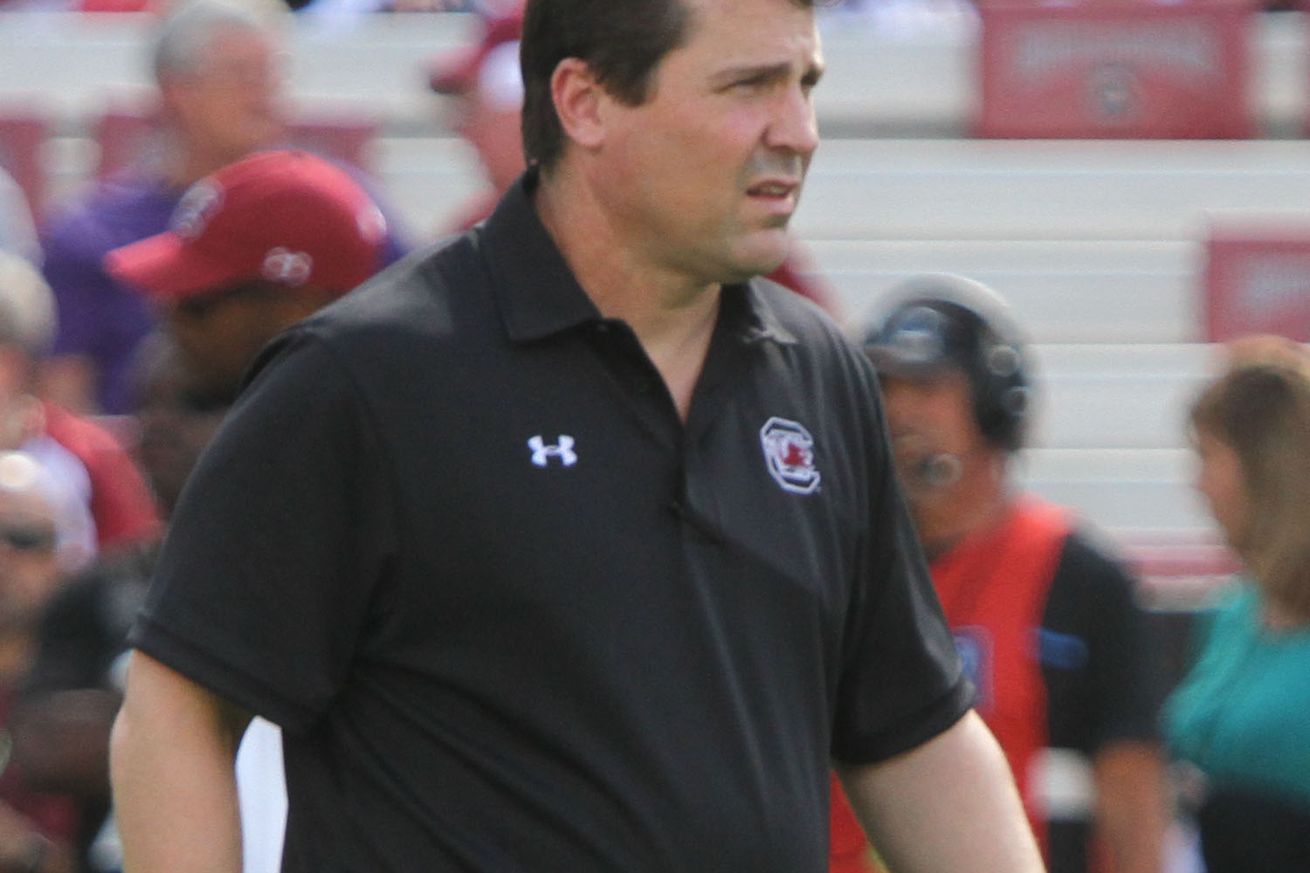
Michigan State is now in the midst of a three-game losing streak following a 31-14 loss to BYU.
Head coach Mark Dantonio said it best during his postgame press conference in that it’s a lot easier to slide backwards than it is to climb forwards. The latter is what he hopes to get the Spartans doing more going forward, but it’s going to take a lot of work to get there.
“As I told our football team after the game, I believe this program has been built on a good, solid foundation. It’s taken nine years to do that,” Dantonio said. “The ride up the mountain’s very difficult at times, and that ride down sometimes is very quick.”
Here is a video of Dantonio’s postgame remarks, courtesy of Spartan Sports Network.
Up next for the Spartans: They resume Big Ten play with their Homecoming game against a 2-3 Northwestern team next Saturday.
Pain. Hurt. Heartbreak. These are just a few of the emotions that the FSU football community is feeling right now.
Another week passed means another episode of ‘A Season With’ to come, and this week the Seminole’s unravel and their issues become exposed. In this episode, viewers will witness another heartbreaking loss and the way this Florida State team reacts.
While many will focus on the negative, it is moments like these where the leaders on this team step up and rally the team to recommit to the program. It’s easy for fans to smile and love a program that’s playing well, but it’s harder when issues arise and the team is facing obstacles. Viewers now watch to see how much of the internal struggles that Showtime will reveal, and how the coaching staff handles the amount of press around a crumbling season.
Tune into Showtime tonight at 10pm and comment your thoughts on this week’s episode below.
The Huskies played their game of the season last Friday night, and while they may not have such a near-perfect effort again, they dominated Stanford by simply playing sound, physical football. Before we begin clearing a space in the trophy case for the BCS crown, we should consider that Stanford may not have a terrific offense. Their QB came into the game 13th in passing yards in the Pac-12, and concerns about the Cardinal offensive line were voiced before the game.
Still, teams have not done what Washington did to Stanford in the David Shaw era. Today we’ll shed some light on why the Dawgs were so dominant on the defensive side of the ball.
2nd and 11:
This first play is an I-formation power lead. It’s similar in design to the power runs Lavon Coleman used against Arizona for so much success, in that there’s a pulling guard from the left side leading a back through the hole on the right. This particular version of it would have been something the Green Bay Packers used in winning back-to-back Super Bowls in the 1960’s.
This play, from this formation, is the height of Stanford’s offensive arrogance. I don’t mean that in a bad way, to be clear. Typically, the I-formation has two receivers (one to each side), with a tight end, and two backs behind the QB. In this case, Stanford has removed the receiver (the flanker) from the offense’s right side and replaced him with an additional tight end. What makes this play “arrogant” is that the second tight end is on the line of scrimmage, which makes the tight end inside of him an ineligible receiver (only the furthest-out man from the ball on the line of scrimmage is allowed to move beyond the line of scrimmage on a pass play). This play is a bludgeoning tool. Stanford is perfectly content to telegraph the run by formation and alignment, and then run this play over, and over, and over again until the defense stops it; and then run it a few more times to make sure that first stop wasn’t just a fluke. Somewhere in the middle there they’ll run the pass compliment out of it, which is a bootleg or half-roll to the right side, with the tight end, fullback and halfback running a multi-layered flood route to the right side, and the receiver on the left either running a post or deep drag back to the right. This is a play that is both mentally and physically draining on a defense (when it works); you know what’s coming, but there’s nothing you can do to stop it.
Two things make this play. The first is Sidney Jones’ willingness and ability to neutralize the lead block of the fullback, well behind the line of scrimmage. One of two things happened here with Jones; either Stanford ran this play in to a well-timed run blitz by the Huskies, or the defensive key on this play was for Jones to attack the backfield due to the formation, with the knowledge that the safety (Budda Baker) and the linebackers would be available and able to neutralize the threat of the pass. Either way, he takes out the lead blocker.
The second key is that Psalm Wooching is able to defeat the block of the tight end (#96) over the top of him, and then to suck up the block of the pulling guard as well, keeping him from getting to the second level linebackers and leaving them free to get the glory of making the tackle. Stanford’s right tackle initially gets a good block on Elijah Qualls, but Qualls keeps his feet and is able to assist on the tackle. Had the timing of the play been better from the standpoint of the offense, Qualls would’ve been a non-factor. Greg Gaines more than does his job by taking on the down-blocking right guard and pushing him backward into the hole, creating traffic for the running back to negotiate.
This was man-on-man football, and the Huskies won pretty handily.
Here you can really see the aggressiveness of the UW secondary in run support, and how stout Wooching was at the point of attack. Azeem Victor reads the flow of the play and takes away the outside run from McCaffrey. Great hustle by Qualls as well.
3rd and 11:
This play is an “end-tackle twist” on the left side of the Huskies’ defense, on an obvious passing down. Instead of rushing straight up the field on the snap, Elijah Qualls works to the outside and attacks Stanford’s right tackle. The right guard also steps out with Qualls, failing to notice Psalm Wooching patiently waiting on a looping upfield rush. As soon as the guard fully commits to double-teaming Qualls, he creates a lane for Wooching to cut inside and straight to the quarterback. Wooching is far enough upfield before coming back inside to the QB that he’s outside the fullback’s (#82) field of vision. The fullback notices him far too late to actually do anything to affect Wooching’s rush.
Wooching gets the stats on this play, but the key here is actually the rush ability of Elijah Qualls, and the respect Stanford shows his ability to rush the passer. Had Stanford’s right guard known that the tackle could handle Qualls, he would’ve held his position in the pocket, and been in position to pick up Wooching’s late rush.
Watch Stanford’s right tackle’s (#77) head; the outside rush of Wooching plus the outside release of Qualls puts him in stress. The right guard fails to engage Qualls in any meaningful way at the snap, and then chooses to follow Qualls up the field instead of looking for a rusher coming through his zone. You can see him realize that mistake, just a moment too late.
2nd and 6:
Stanford tries to get fancy, and it blows up in their collective faces.
The Tree really try to sell the run to their left, pulling both guards as lead blockers. But this play is dead from jump street, as Conner O’Brien gives a clinic in “How to Play Outside Containment While Not Getting Blown up by a Quarterback’s Block” that he may autograph and send to Arizona’s unfortunate defensive end
O’Brien is smart and patient; he diagnoses the play and instead of simply attempting to defeat the block of Ryan Burns, he strings out the play laterally by keeping himself parallel to the line of scrimmage and waits for the cavalry. This is the smart play, because attacking Burns could’ve potentially created a cutback angle.
By quickly and correctly diagnosing the play, and then maintaining the outside containment instead of attacking the ball carrier up the field, O’Brien makes this play. It’s just a matter of who’s going to get the glory for actually making the tackle and for how many lost yards. Keishawn Bierria whiffs at the first attempt, and then in a bit of poetic justice, O’Brien finishes the ball carrier off.
Look at how quickly Bierria reads this play, and then closes on the ball carrier. That’s great speed. Vita Vea also reads the play, and is one of the four Huskies working in tandem to hem in this play.
1st and 10:
This is an inside power run to the offense’s left, and Stanford is pulling both its center and right guard. But then Elijah Qualls happens.
Stanford’s right guard absolutely whiffs on his down block attempt on Qualls, who is lightning-quick off the snap. His penetration negates any opportunity of the play succeeding to the left.
But the running back is Christian McCaffrey, and he frequently makes big plays in this situation, and as we’ve previously documented in this film study, the cutback to the opposite side of the field is frequently available for a big gain out of this play (although typically more fluid than on this play).
Credit is due to Stanford’s QB Ryan Burns on this play. He sees the cutback by McCaffrey, and then works up the field as a blocker. And he actually gets a decent block on Jojo Mathis.
What turns this potential broken-play big-gainer into a mundane gain of two is the recognition and patience of Sidney Jones. Jones doesn’t bite on the receiver’s attempt to run Jones out of the play, and has the awareness to see McCaffrey cutting back against the grain. Instead of attacking the ball carrier and potentially creating a cutback lane, Jones squares himself to the line and simply waits for McCaffrey to come to him. Jones, McCaffrey and Keishawn Bierria all arrive at the same point in time and space, and it’s an easy tackle.
There’s nothing highlight-worthy on this play outside of Qualls incredibly quick reaction off the ball. But it’s the perfect example of the Washington defense playing smart, patient, assignment-sound defense in bottling up what has been an electric offensive player.
All-American Sidney Jones, doing All-American things. Enjoy him while he’s here, because the countdown is on for this man to be a millionaire.
3rd and 10:
This play ended up as a personal foul penalty (and phantom holding by Jones) against the Huskies and a Stanford first down, but it’s worth looking at for a couple of reasons.
First things first. If I was an offensive lineman, I’d probably pee my pants at the thought of having to block Elijah Qualls lined up in a four-point stance two feet away from me. But Elijah Qualls with a perfectly-timed five yard run at me? No thanks. I quit.
This is an end-tackle twist, with Qualls lined up as a blitzing linebacker. He runs through Stanford’s right guard, and straight at the right tackle. Conner O’Brien is the twisting end on this play (instead of Wooching from the first example), and you’ll notice he doesn’t get as far up the field as Wooching. The right guard recovers from Qualls’ bull rush, and is able to slow O’Brien’s free rush down. O’Brien ends up hitting the quarterback in the face for a penalty. It’s an effort play on his part, so it’s tough to be too upset with him. But the real beauty of this play is the different ways the defensive coaches found to deploy Qualls in this game, and the willingness of Qualls to give himself up as a decoy so his teammates could enjoy the glory.
The second part of this play worth watching again-and-again-and-again is the simple joy of appreciating Sidney Jones in man coverage. Jones was called for holding on this play, but you can see the penalty was actually on Taylor Rapp in coverage of the tight slot man coming across the field. The receiver gets an inside release on Jones, but Jones knows he has Jojo McIntosh in deep help (this is a Cover 1 defense, with man underneath and a single free safety “helping” from a very deep position). Really though, Jones baits this throw. He knows he has the speed to essentially recover from his trailing position at will. Ryan Burns throws a good-but-not-great pass, and Jones easily cuts in front for a huge interception.
It was all for naught, but still an example of great defensive design and execution.
2nd and 7:
The Huskies are in their 2-4-5 nickel, and this play is “bullets” rush from the two ends. The goal is to meet at the quarterback. And that’s what happens.
Psalm Wooching makes a great move on this play. His initial rush is thwarted by Stanford’s left tackle. Instead of just continuing to bull the tackle, or to run around him, Wooching gives what’s known as a “push-pull” move to get the tackle slightly off balance. Wooching attacks the left shoulder of the tackle and gets him leaning in that direction. He then quickly pulls the tackle back to his right (Wooching’s left) to get him off balance. Wooching is then quick enough to use that slight gap to get around the tackle and to the quarterback. And the secondary is able to cover long enough to make the rush pay off.
On the other side of the line of scrimmage, Elijah Qualls is aligned as a four-technique end (over the inside shoulder of the offensive tackle). Jojo Mathis has aligned himself as a nine-technique end (outside of the tight end). Mathis is in a speed rushing position. He’s easily quick enough to duck underneath the attempted block of the right tackle, and strong enough to blow through Christian McCaffrey’s half-hearted attempt to assist.
Hopefully this angle gives you a better visual of Wooching’s move; as he’s working upfield, he pulls the tackle off balance and back to the inside.
This is just great effort by Mathis, even though he doesn’t make the play.
3rd and 13:
Most 3-4 teams struggle to find one true fire plug to clog the middle of the line and demand a double team on each play. The Huskies have three guys that can legitimately get that job done, in Qualls, Greg Gaines, and Vita Vea.
On this play, the Huskies have two of them in the game. Qualls is lined up as a three-technique tackle on the defense’s right, between the guard and tackle. Gaines is lined up as a two-technique tackle, over the right guard. Stanford’s center ends up helping the left guard block Qualls, leaving the right guard one-on-one with Gaines. But at the snap, you’ll notice in the gif below that the center isn’t really doing anything of any real value, until Qualls spins to the inside. Gaines is slanting to his right, and is quicker off the ball than the guard – who actually should have the advantage here. Credit the crowd noise for making a voice cadence almost impossible Friday night.
You can really see that Stanford’s center offered no real value to the offense on this play. He doesn’t recognize Gaines’ inside slant.
Welcome to Ryan Burns’ world. Seeing that much humanity coming at him right off the snap has to be frustrating. Great effort by Gaines.
4th and 2:
The first amazing thing about this play is the concession Stanford is making here. It’s 4th and 2, and Stanford is going to throw the ball.
Psalm Wooching is showing coverage on this play head up on a receiver in a tight slot. He’s on a delayed rush, which allows him again to pick his rush lane. In this instance, Elijah Qualls and Greg Gaines are in the same alignment they frequently show in this nickel defense (it’s essentially an “under” front, with Qualls on the offense’s weak side in the 3-tech, and Gaines is in the 2-tech). Gaines is slanting to the inside, and Qualls is working up the field in the same twist we’ve already seen. Wooching pauses, and then takes the route unencumbered to the quarterback. Had he not been there to make the tackle, Qualls almost undoubtedly would have. Wooching’s initial alignment in coverage means that the offensive line doesn’t account for him in its pocket protection.
Credit again to Qualls; he’s off the ball at the exact moment the offense is. He’s working upfield to create the lane for Wooching, but gets pushed inside toward the QB. So, he decides he might as well go ahead and make a play….
Ryan Burns just didn’t have much fun out there on Friday. He does an admirable job of keeping his eyes down the field, but you can tell that he’s feeling the rush long before it actually gets home. Let’s also credit Bierria on this play; the guy leads the nation in fumble recoveries (4) and there is a reason. How often do you see defensive players attempt to pick up the ball or just dive on it. Bierria uses perfect technique of sliding to the ground and gathering it into his body (in this case, swiping it out from under the 300 lb ass of RT Casey Tucker). It was 4th down so the recovery was academic, but he has done this throughout his Husky career.
This was an incredible defensive effort for the night, both for the fact that it was mostly simple in design (which makes it imminently repeatable), and that it was such a total team effort. To a man, the Huskies simply did their jobs play in and play out. Psalm Wooching ended up with the individual rewards in the game and in the media afterward, but the plays that he made were in large part due to efforts of his teammates.
The Huskies dominated Stanford by being more physical along the line of scrimmage. Oregon presents a much different type of challenge; they aren’t a physically dominant offense, but instead are built to create and attack space, with speed. It’s a good thing the Huskies physically dominating defense also happens to be exceptionally fast….
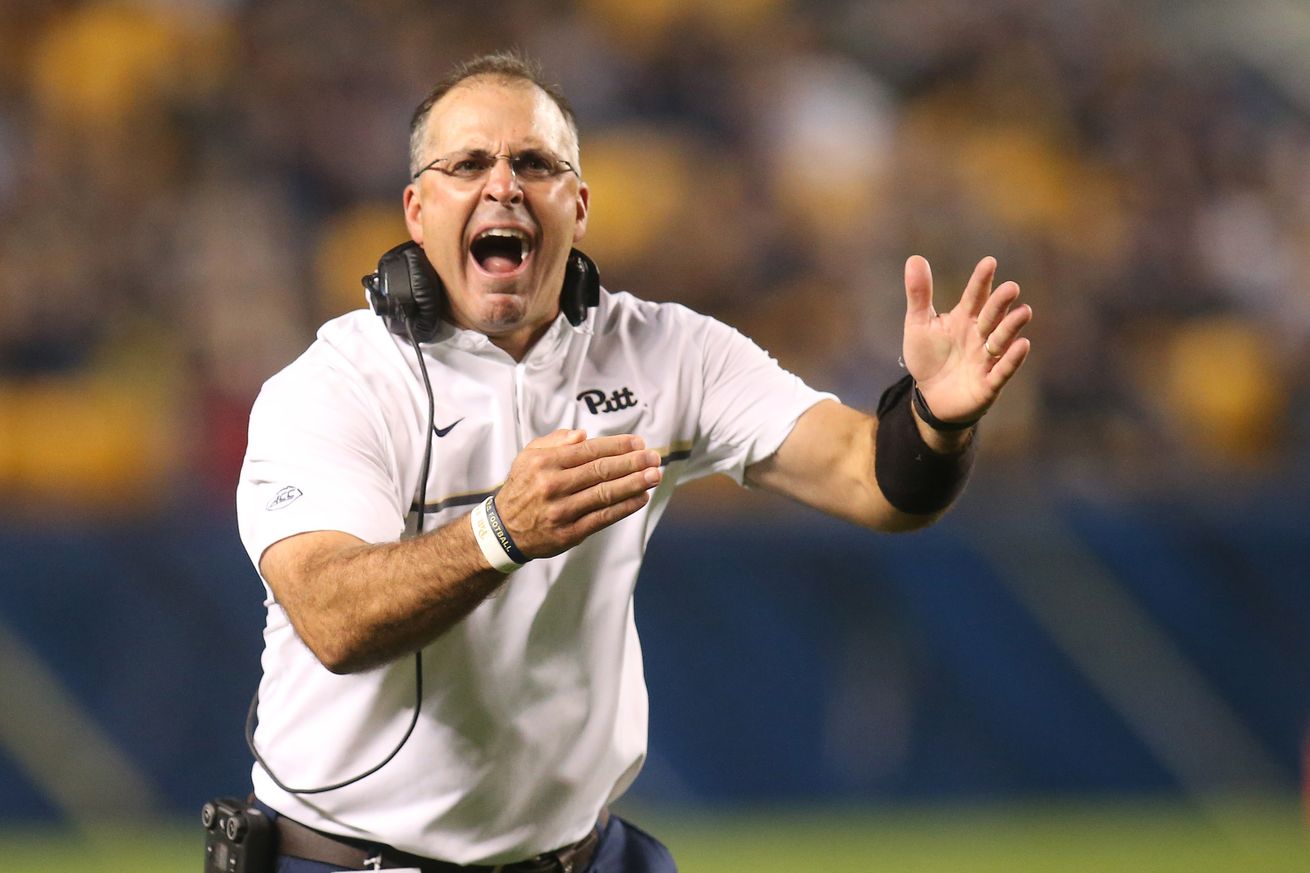
So, I freely admit to nearly having a panic attack when I saw the email from Pitt’s medial relations with a statement for the press from head football coach Pat Narduzzi.
I immediately assumed it to be regarding the status of safety Jordan Whitehead, which has been a hot topic since he sat out last weekend’s game against Marshall. I had that part right but fortunately, it wasn’t the bombshell announcement you might expect when a coach issues a full-out press release based on one player missing a single game:
“As head football coach, I feel a tremendous amount of responsibility for the well-being of our players. That includes protecting their privacy when appropriate. Jordan Whitehead did not play in last week’s game for reasons that are personal in nature. I won’t comment further on the topic other than to say I fully anticipate that Jordan will be available to play this coming Saturday against Georgia Tech.”
Obviously this still sheds little light on why Whitehead missed the game and still doesn’t even address if it was related to an injury or not, if we’re being technical. By stating that it was personal, I guess we’re supposed to glean that it is not injury related, but the statement is still incredibly vague.
Ironically, the statement by Narduzzi today seems to be him trying to clear the air with the media here since so much has been made of the entire situation. But a statement wouldn’t have even been necessary if Narduzzi simply mentioned if it was injury-related or not. Sure, media would have wanted to dig a little further perhaps since that’s their job. But I think much of this could have blown over rather quickly with Narduzzi simply addressing if it was injury-related or not after the Marshall game. By not doing that, it, unfairly or not, raised all sorts of raised flags.
I’m all for protecting players and applaud Narduzzi for seemingly wanting to do that here. But the injury/no injury thing is such a harmless question that it seems like it should have been addressed from the get go.
The further this goes, the more attention it continues to draw. Now we know that it’s some kind of personal issue and while I don’t think the media and fans need to know every detail about every player, the whole way this entire thing has been handled remains incredibly odd. If Whitehead suits up this week, I expect it will blow over in relatively short order. But if not, then what?
Here’s what’s making news this morning in Bulldog Nation.
After reviewing the tape, Coach Smart said yesterday that every Georgia player on the field for the final play “executed their job”. Full disclosure: I have reviewed it over and over and I have to agree with him. Should one of the Bulldog players simply interfered with receiver Jauan Jennings, dragging him to the ground? Maybe. But the game can’t end on a defensive penalty. So that’s only a temporary reprieve.
Should Lorenzo Carter have taken up position in front of Jennings? Maybe, but it wasn’t as if he ran down and stood there. Instead Carter found himself walled off by mostly red-clad defenders. In the end Jennings timed his jump perfectly and Josh Dobbs put the ball right on the money. It was, in the end, a miracle play.
These shirts make me so, so sad. Also if I were a Tennessee fan I would probably buy one, and if that touchdown to Riley Ridley had turned out to be the game winner, you’d best believe we’d have printed up a diagram of it for tee shirts, koozies, coffee mugs, and adorable Tennessee-gutting baby onesies.
But life moves on.
Nick Chubb was back at practice Monday, and in a non-contact jersey. That’s about the best thing that’s happened in Athens since about 7:14 p.m. Saturday night. Assuming that Hurricane Matthew doesn’t delay the Dawgs’ shot at redemption for another week, having Chubb available could be a great way to steady the Bulldog offense, especially since Jacob Eason is looking ever more ready to win games with his arm.
Jonathan Ledbetter may be back after the South Carolina game, though the defensive line he’ll join is a good bit more seasoned than it was when Ledbetter was running with the ones in preseason camp.
Georgia will kick off next week’s Homecoming game at noon on the SEC Network, which is definitely not a recipe for lackluster fan support, tepid effort, and impending disaster. Nope, not even a little bit.
Carolina Blue | Ross Martin: After all the hype surrounding Mitch Trubisky heading into the season, it looks like he’s lived up to everyone’s expectations, and maybe even more. With his efficiency, production, and skill he could help UNC compete for another ACC Coastal title.
Inside Carolina | Greg Barnes:Mitch Trubisky’s success over the last few games has pushed him into the Heisman race. Still, he will face a major test from Virginia Tech and Miami, two tough defensive teams.
CBS Sports | Matt Norlander: The North Carolina vs. Kentucky game on December 17 is considered to be one of the top non-conference college basketball games for the 2016-17 season.
Associated Press | Aaron Beard: North Carolina’s last two victories have built up their confidence just in time for them to take on a tough opponent in Virginia Tech. Being able to win by such small margins within the final seconds of a game has given them a reputation for never giving up.
The numbers prove what our eyes already know: Bob Shoop and Josh Dobbs are significantly stronger as the game goes on.
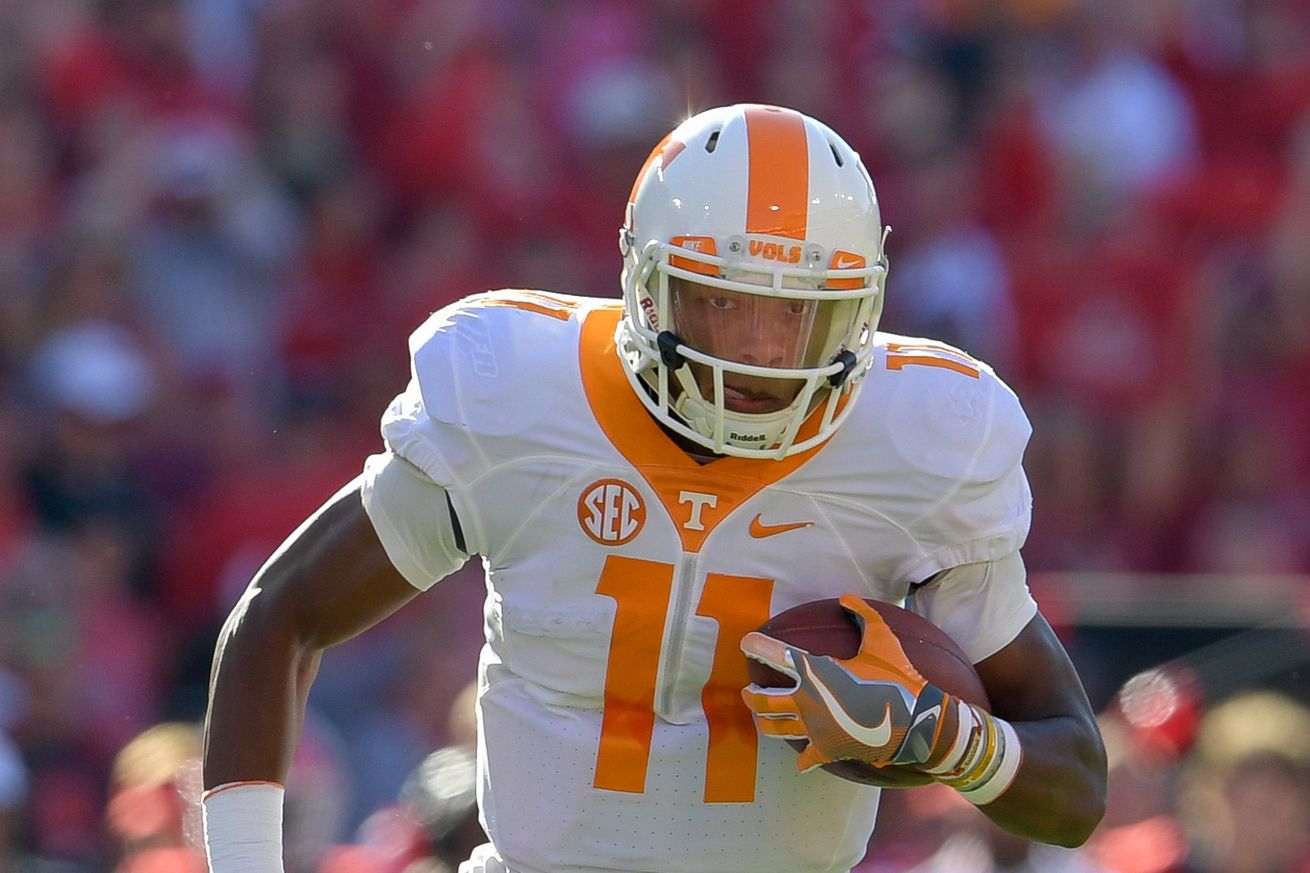
A look at Tennessee’s advanced statistical profile shows a couple of clear things the Vols have excelled at. One, to no surprise, is field position: Tennessee’s average starting field position is its own 37 yard line, second best in the nation. And the opponent’s average starting field position is its own 26, 19th best in the nation.
Just behind field position advantage has been Tennessee’s defense in preventing explosive plays. The Vols are sixth nationally in IsoPPP allowed, which is essentially a measure of how explosive an offense’s successful plays are. Tennessee has allowed only 16 plays of 20+ yards, 10th nationally among teams who have played five games and tied with Alabama and South Carolina for the best in the SEC.
Here are the 16 20+ yard plays the Vol defense has allowed:
1Q Appalachian State: Marcus Cox 20 yard run (two plays after Cam Sutton fumbled the punt, led to first AppState touchdown)
2Q Appalachian State: Marcus Cox 33 yard TD on the wheel route
1Q Virginia Tech: Jerod Evans to Sam Rogers for 30 yards (led to first VT touchdown)
1Q Virginia Tech: Travon McMillian 69 yard TD run
2Q Ohio: Greg Windham to Sebastian Smith for 42 yards (led to field goal)
2Q Ohio: Greg Windham to Sebastian Smith for 29 yards (led to field goal)
3Q Ohio: Greg Windham to Sebastian Smith for 37 yards (led to touchdown)
1Q Florida: Austin Appleby to Antonio Callaway for 51 yards (led to touchdown)
1Q Florida: Austin Appleby to Antonio Callaway for 43 yards (led to touchdown)
2Q Florida: Austin Appleby to Antonio Callaway for 20 yards (led to touchdown)
2Q Florida: Austin Appleby to Tyrie Cleveland for 36 yards (same drive, led to TD)
2Q Florida: Austin Appleby to Antonio Callaway for 20 yards (led to punt, final drive of half)
4Q Florida: Austin Appleby to C.J. Worton for 22 yards (led to final TD)
2Q Georgia: Sony Michel run 22 yards (second play after Hurd fumble, led to TD)
3Q Georgia: Jacob Eason to Isaac Nauta for 50 yard TD
4Q Georgia: Jacob Eason to Riley Ridley for 47 yard TD
Twelve of the 16 20+ yard plays the Vols have allowed have come in the first half. One of the four that didn’t came on Florida’s final drive with the Vols playing softer coverage and the gain only good for 22 yards. Ohio and Florida clearly had fun with Cam Sutton’s absence.
Whatever Bob Shoop is doing at halftime, it’s working. Appalachian State got zero in the second half. Virginia Tech got three on the starters. Ohio got seven. Florida got five straight three-and-outs and an interception before needing 16 plays to get their only score of the second half.
In the second half last week, Georgia basically got only big plays. Their drives went punt, 50-yard touchdown, three-and-out, failed fourth down conversion, three-and-out, end zone fumble, interception, 47-yard touchdown.
First half Bob Shoop is on the hot seat. Second half Bob Shoop is a head coach waiting to happen.
And he’s not the only one transforming in the second half:
Josh Dobbs
CMP
ATT
PCT
YDS
TD
INT
YPA
CAR
YDS
YPC
First Half
39
74
52.7
404
3
3
5.5
29
91
3.1
Second Half
38
59
64.4
631
10
3
10.7
36
176
4.9
First half Josh Dobbs is an average quarterback. Second half Josh Dobbs is a Heisman candidate.
How do the Vols fix it? Fewer drops would help. With a five game trend now it’s easy to say play-calling should be called into question, but simple execution is just as likely a suspect. The Vols did get their offensive act together before halftime against Virginia Tech and Georgia (and the opening drive against Ohio).
Whatever the Vols are doing early, once they get rolling they don’t get stopped. Florida (2nd) and Virginia Tech (9th) are Top 10 defenses in yards allowed, and both ate a 30+ point run from this team. With Texas A&M and Alabama next, the need for the Vols to get going sooner has never been greater.
I’m honestly not sure why he brought up Auburn specifically (more on that at the end), but he did. It’s not like Jimbo has just spent tons of pointless time studying Auburn film past 2013’s BCS title game since it’s been unlikely his Seminoles would face Auburn after that, so he would hardly be in a position to know exactly what Auburn’s offense does and does’t do at this point. He cited two specific situations, though, so, let’s take a look at them.
The Marshall-to-Coates Pass
This is the primary one Jimbo cited. According to AL.com, Jimbo said Auburn had a lineman “7 yards down the field.” I don’t know about you, but no where in that video do I see a linemen 7 yards down the field. I see Jay Prosch blowing someone up 5-6 yards down the field, but as a fullback who lines up in the backfield, Prosch is well within his rights to go down field. The line is very close to being 3-4 yards downfield, but it’s bang-bang on when Marshall throws the pass.
From this picture, you can see the Kozan is just barely beyond 3 yards down field, but you can also see that the ball has already left Marshall’s hand. That play was called correctly. Sorry, Jimbo.
Of course, the funniest part about this particular play is that he said it cost Alabama a national championship. So, he’s implying that Alabama would have beaten his Florida State team in the BCS Championship Game that season.
2015 Ole Miss Game
This is the strangest one, to me. He said that when Auburn played Ole Miss last year “they had a guy 6 yards down field.” It does indeed seem to be the case from the cutups WarRoom Eagle did that Auburn had a man downfield illegally at one point. However, note his comment in the tweet:
I found it! Four yards, not six, but still illegal.
Plot twist: The refs penalized Auburn!https://t.co/ekqgrBe1Zy
He may have a legitimate complaint about teams that are very heavy on the run-pass-option (RPO) plays, but here’s the thing… Auburn isn’t one of those.
While many teams use it extensively, Auburn doesn’t have many of them. WarRoom Eagle even broke down just how little Auburn used RPOs in 2013 & 2014 with Nick Marshall as the QB. He discovered that Auburn had all of two of them in the playbook, and one of those was a screen pass that wouldn’t result in a lineman illegally down field, anyway. That is missing 2015, of course, but it’s not like Auburn was successful on much of anything in 2015 on offense.
I don’t know what Jimbo was getting at with all of this. Perhaps it was a way to deflect from the fact that his team has struggled in a few games this season, and they’ve played teams (Ole Miss, Louisville) who have more RPOs in their play book. They beat Ole Miss, but Hugh Freeze’s playbook has quite a few more RPOs (and they use them much more often) than Auburn does, so it seems like they would have been a much better example.
I’m not saying Jimbo is wrong to complain about teams having illegal men downfield when running RPOs. I just think it’s dumb to use Auburn as your poster child for it. It’s reaching to try to bring in one of the more famous plays in the last few years and call it out as illegal when, in fact, it wasn’t.
When a roster is as loaded as this one, some attrition can be mutually beneficial to the program and the player.
If you follow Alabama football closely, you know that there has been no shortage of opinions shared over the past week on Blake Barnett’s abrupt decision to pack up and leave town. At issue is not the decision to transfer after being passed up by the younger Jalen Hurts.
That was to be expected.
The timing, however, seemed rather unusual, at least until it was revealed that Barnett may be able to take advantage of an apparent loophole that would allow him to gain eligibility at another FBS program by week five of the 2017 season.
Should he prove successful in his efforts, he very well could set a precedent that would open the door for many other such transfers in the future, potentially changing college football in a meaningful way. To many fans, this would be a negative change, something akin to free agency in the professional sports world where fans routinely root against a player one season before becoming his biggest fan once he dons their preferred team’s uniform. Some overly dramatic fans might even call it the end of college football as we know it, and Alabama fans are particularly scarred since Barnett is just the latest of several high profile transfers from the program over the past few months.
The prevailing thought is that seeing elite recruits transfer out after short careers could cause other elite recruits to think twice before committing to a loaded Alabama program.
But what if the opposite is true?
Thus far, roster attrition has had little to no impact on the Nick Saban recruiting machine, and that doesn’t seem to be changing. Alabama currently holds commitments from three of the top five 2017 players on the 247 Composite and by all measures will have an outstanding class when all is said and done. With the program clearly entrenched at the top of the football world, opposing coaches’ best recruiting pitch against Alabama is an already loaded roster that could make seeing the field early a difficult proposition. Indeed, they can cite the transfers of former five-star prospects Barnett and Kendall Sheffield as examples of players who could have started as freshmen at other programs.
There may actually be a way, however, that Saban and company can spin the transfers into a positive.
Think about it. The Alabama coaches can look a kid in the eye and tell him that they truly believe he has what it takes to come in and compete at this level. While there is no promise of playing time, the coaches can cite several true freshman contributors as evidence that early action can be earned. By his sophomore year, the prospect should be on the field and helping to hoist that trophy. And if that doesn’t happen for him?
No harm, no foul.
Worst case scenario, you will spend over a year in the best player development program in the country. You will practice against the best competition in the country. If you aren’t able to win playing time for some unforeseen reason and decide to go elsewhere, you will leave a much better player than you are now and we will support you in your effort to transfer. In short, you will either help Alabama win championships or be better equipped to shine elsewhere.
That should be music to the ears of a five-star prospect with NFL dreams. Telling the player up front that he will have the program’s full support if it doesn’t work out in Tuscaloosa should assuage any fears that he won’t gain the exposure needed to catch the eye of NFL scouts, and every player who does transfer out opens a scholarship for another elite prospect who wishes to come in and compete.
In addition, competing with players of this caliber will allow the player to truly assess whether NFL riches can be a part of his future, and adjust accordingly. He may decide to simply stick around for four years, get on the field as much as he can, and enjoy being a part of a championship program as he earns his degree.
Alabama ends up with an even more loaded roster and becomes something of a farm system for college football.
You know, 15-yard penalties aren’t always the worst thing. Make Football Fun Again!
There were plenty of awesome moments during WSU’s beatdown of Oregon on Saturday night, but I’m toying with the idea that my favorite one wasn’t even an actual play.
Cole Madison got himself a 15-yard penalty on behalf of the group for this little demonstration, which everyone knows is BAD, but you know what’s good?
This team finally looking like football is fun again.
Different teams deal with the weight of expectations differently, and while I try to avoid playing sports psychologist, it sure looked like this particular collection of players was tight right out of the gate. It’s the kind of thing that makes fans question the actual talent level of their team when it can’t stop an FCS opponent and looks frustratingly slow doing it.
Then Boise State happened, and it sure felt like there were all sorts of opportunities missed that could have turned the game in WSU’s favor, but the team was again unsure of itself, making us wonder if we had it all wrong to begin with.
Someone convinced somebody that they could do the exact same thing and shove the football right up Oregon’s ass.
I have no idea who was pushing the point, or if it was even explicitly said, but I know this: In the ultimate demonstration of belief in WSU’s ability to physically dominate Oregon, Luke Falk handed the ball off in a number of situations that would have defaulted to “pass” in past years. Defenses often try to disguise what they’re doing to make WSU think they’ve got six guys in the box to discourage a run before sending one of those guys directly into coverage. On Saturday, Falk looked at some of those six-man boxes and said, “LOLOLOLOLOL fine leave six guys in there because that’s not even going to stop us.”
A great example is Gerard Wicks’ four-yard TD run on the first play of the second quarter. Oregon’s got six guys clearly in the box and not only does WSU run it anyway, it just doesn’t matter because four of our linemen wash out their entire front — seriously, if you want to see something funny, watch Madison (the right tackle) try and find someone to hit as his running back is slamming his way into the end zone:
Here’s an even better one: Morrow’s first TD. Oregon’s got six in the box with a seventh immediately running downhill in run support, and this time … Morrow scampers in untouched.
Is it any wonder that play resulted in a celebration penalty? It’s like a swagger switch flipped on — “We knew Oregon couldn’t stop us and YEP WE WERE RIGHT.” The result was a loose, confident bunch of guys that looked about as different as could be from that group that crapped the bed against Eastern Washington. And if a 15-yard penalty is the price to be paid? Well, as left tackle Andre Dillard said when he met with the press on Monday, “It was worth it.” He also added, “To an extent,” because of course you can’t do this after every touchdown or every week.
But for this team in this moment? Yeah. It was worth it.
The fascinating thing to me is that this physical nature appears to be quickly becoming the identity of this offense. Football is a physical, violent game, and while Mike Leach has insisted that his teams can and will be physical even while throwing it 60 times a game, some teams really just need to punch people in the mouth* to feel that.
*Not literally, guys.
Beyond that, it seemed like for the first couple of games, everyone was looking around for someone to fill the leadership void left by the guys who graduated, take up that leadership mantle, and light a fire under the team. Gabe Marks seemed like a great candidate, but it’s hard to do when you can’t catch the ball because teams are rolling two and three guys at you in coverage on every play. (That’s not an exaggeration; Jason Gesser has a film breakdown on WSU’s Gameday app of Luke Falk’s 10-yard scramble, and there are literally three guys covering Marks.)
Eventually, these guys figured out that everyone had to do it, and they’ve done it by collectively smacking their last two opponents around.
Teams will adjust to what the Cougs are doing, probably as early as this Saturday. But here’s the thing: There’s absolutely zero mystery to it. This isn’t smoke and mirrors, which means Stanford better be ready to hit — and there actually are serious questions about whether the Cardinal will be ready to do that after getting truck sticked by Washington on Friday.
And if Stanford isn’t Stanford and the Cardinal are forced to adjust by dropping a seventh guy closer to the line of scrimmage … well, that’s when the passing game takes off. This is how the Air Raid is supposed to operate. Do you realize WSU still dropped back to pass on 60 percent of its plays? That’s pretty darn close to the sweet spot, which I’d guess is around 65 percent, if Leach had his druthers.
That’s when this offense gets vicious. That’s when it gets fun again.
What We Liked
Brian Floyd wrote on Sunday about this team being on script, and it’s hard not to look at 2015 and see this season following a similar narrative arc. Could Boise State have been this season’s Cal? Could Oregon have been this season’s, well, Oregon — just a game earlier?
It sure seems like these guys are figuring it out faster than last season, which is obviously a really good sign, since Stanford and UCLA loom in the next two weeks.
A big part of this is Falk taking a big step forward this past week to reclaim his status as the Crimson Messiah. There still were times it appeared he held onto the ball a little bit, but on the whole, he seemed much more decisive and in command of the offense. Incredibly, he threw for 371 yards on 36-of-48 (75 percent) for a pretty good 7.7 yards per attempt … and was a complete afterthought.
I don’t know if that’s the way Falk would prefer it, but here’s to betting he didn’t mind it one bit.
Who Impressed
James Snook-USA TODAY Sports
Shalom Luani, step right up. With Parker Henry sidelined with a case of Happy And Healthy, Luani has shifted from his role as free safety into nickelback.
And he’s been awesome.
It shouldn’t be a surprise that he’s thriving in a hybrid DB/LB role; although he’s only played safety here up until a couple of weeks ago, he’s a hard-hitting guy whose strength is his ability to roll downhill at a guy with the ball. Having him in that nickel against the run-heavy teams WSU is currently facing — and Stanford and UCLA certainly qualify — is a huge bonus.
If you haven’t had a chance to watch Gesser’s film breakdown, you should do that. He highlighted Luani’s sole tackle for loss where he shot into the backfield and beat the WR block to smother Royce Freeman just after the mesh point six yards behind the line of scrimmage. It was a tremendously athletic play and the sort of thing I’m sure Alex Grinch visualized when he put together his #SpeedDefense.
Luani was a big part of the reason why, outside of a 75-yard run when the game was more or less already out of reach, WSU held Freeman to just 63 yards on 18 carries.
Also, I’m just going throw this in here because it’s #Speedy and fun and indicative of the way the defense flew around all game:
Thank goodness #SpecialForces didn’t cost us the game, as it (maybe might have) in the first two games. But for goodness sake, CAN WE FIX THIS INEXCUSABLE ABOMINATION OF A PLAY??
This plus another missed field goal in addition to the piss-poor assignment responsibility on Freeman’s TD kept this from looking like the total blowout that it actually was. This could have easily been something like 60-20. That it wasn’t that lopsided was a little bit of a shame.
Up Next
Let’s go cut down some trees: Saturday, 7:30 p.m. from Palo Alto, California. The game will be broadcast on ESPN.



/cdn0.vox-cdn.com/uploads/chorus_asset/file/7213009/CM%20Stuffed%201st%20Q.gif)
/cdn0.vox-cdn.com/uploads/chorus_asset/file/7213015/CM%20Stuffed%201st%20Q%20Endzone.gif)
/cdn0.vox-cdn.com/uploads/chorus_asset/file/7212993/Wooching%20twist%20sack%201st%20Q.gif)
/cdn0.vox-cdn.com/uploads/chorus_asset/file/7212999/Wooching%20twist%20sack%201st%20Q%20Endzone.gif)
/cdn0.vox-cdn.com/uploads/chorus_asset/file/7217285/Blown%20up%20reverse%201st%20Q.gif)
/cdn0.vox-cdn.com/uploads/chorus_asset/file/7213039/Blown%20up%20reverse%201st%20Q%20endzone.gif)
/cdn0.vox-cdn.com/uploads/chorus_asset/file/7213045/CM%20stuffed%20inside%20goes%20outside%201st%20Q.gif)
/cdn0.vox-cdn.com/uploads/chorus_asset/file/7213051/CM%20stuffed%20inside%20goes%20outside%201st%20Q%20endzone.gif)
/cdn0.vox-cdn.com/uploads/chorus_asset/file/7213059/Jones%20Pick%20with%20pentalies.gif)
/cdn0.vox-cdn.com/uploads/chorus_asset/file/7213071/Wooching%20Rip%20Move%202nd%20Q.gif)
/cdn0.vox-cdn.com/uploads/chorus_asset/file/7213077/Wooching%20Rip%20Move%202nd%20Q%20endline.gif)
/cdn0.vox-cdn.com/uploads/chorus_asset/file/7213065/Gaines%202nd%20Q%20sack.gif)
/cdn0.vox-cdn.com/uploads/chorus_asset/file/7213081/Gaines%202nd%20Q%20sack%20endzone.gif)
/cdn0.vox-cdn.com/uploads/chorus_asset/file/7213085/Stan%204thand%202%20fumble.gif)
/cdn0.vox-cdn.com/uploads/chorus_asset/file/7213091/Stan%204thand%202%20fumble%20endzone.gif)



/cdn0.vox-cdn.com/uploads/chorus_asset/file/7214785/Morrow_TD_celebration.0.gif)
 James Snook-USA TODAY Sports