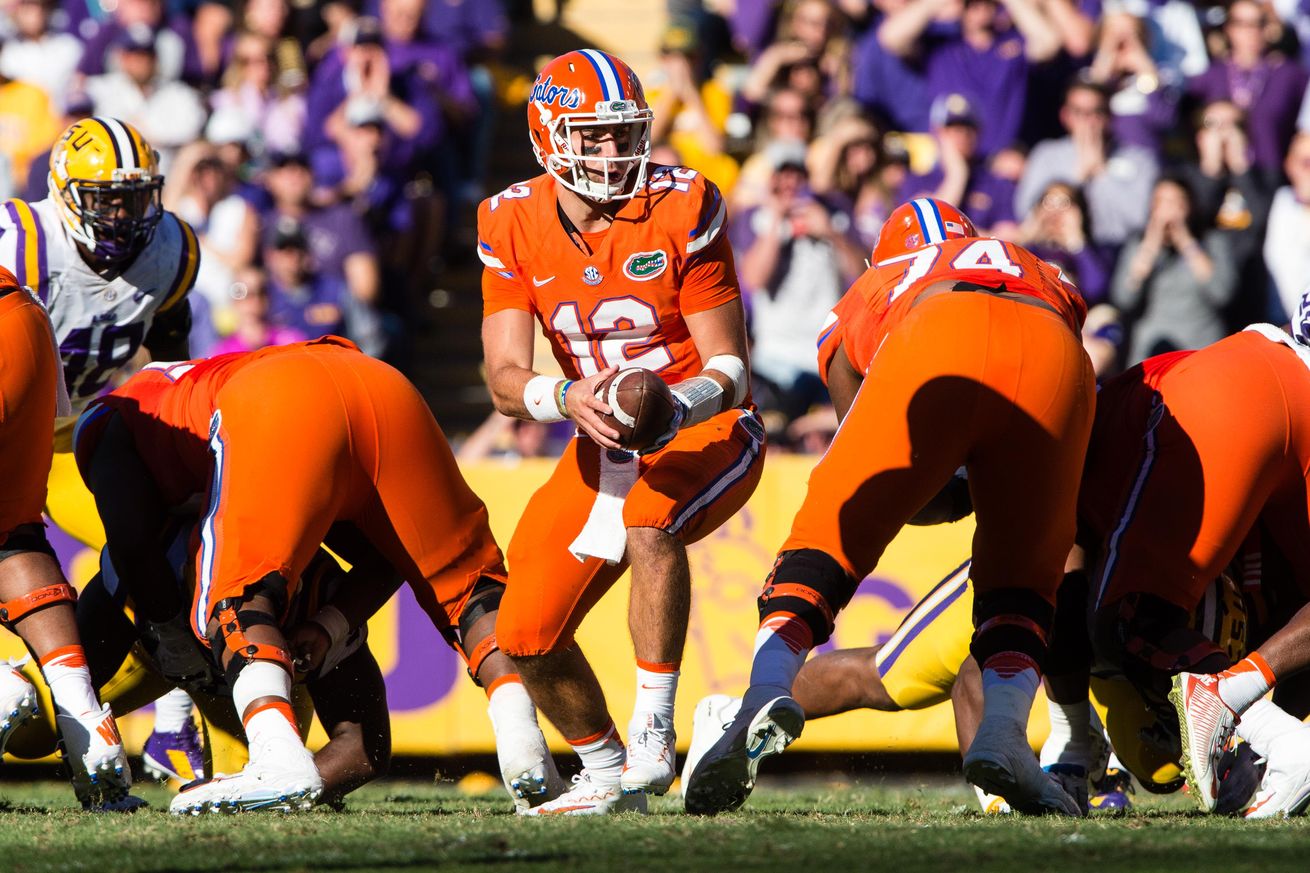
The Gators have an apt defense and an offense that is struggling, to say the least. Can they mount any resistance to Alabama’s Force-choke hold on college football?
It’s a story as old as the SEC Championship Game itself. This Saturday’s championship contest will once again feature two of its most well-known combatants, two blue bloods of the Southeastern Conference who have long represented the power of their respective divisions. Alabama and Florida have met more times in the SECCG than any other two teams, and there’s good reason for it. Both teams have a history of success, and both squads know what it takes to overcome adversity and cipher the championship equation.
Last season, in the most recent chapter of the ongoing saga of the Crimson Tide and the Gators, it was Alabama that had the decided upper hand, trouncing a defensively stout Florida team that had a middling offense, at best. This year’s installment sets up in much the same frame: an all-powerful Alabama team with the nation’s top-ranked defense and a newly-explosive offense meets a Florida team that is limping over the finish line. Despite the storied history of the UF program, this match-up is as much a David and Goliath situation as any the Gators would find themselves in.
The storylines for this game are plentiful, to be sure. There’s the narratorial thread of history woven throughout the team’s previous meetings for all the SEC marbles. Often, when these two teams have played for the SEC crown, the winner has had an impact on the race for a national championship. There’s the continually-evolving tale of Alabama’s dynamic freshman quarterback Jalen Hurts, who seized hold of the job in his first college game and has held fast to it ever since. Hurts is a legend in the making, and in his first SECCG appearance, he’ll write yet another chapter in what will become a classic in Crimson Tide lore. There’s the strand of familiarity between the two head coaches, as not only did Coach Jim McElwain coach under Nick Saban, but he won national championships at Alabama with him. There’s the terrible toll of injury attrition for the Gators that has left a skeletal defensive crew with zero depth at some positions.
Pick a storyline…any storyline. There is plentiful intrigue leading into this year’s contest. One of the few areas of near certainty, however, is the outcome to hear the pundits tell it. Few can imagine any path to victory for a Gator team that has little offensive firepower, and that due to injuries, has a defense that is staggering into Championship Saturday. It’s a mismatch on paper, certainly. Alabama is a team that is ranked in the top-10 of both offensive and defensive S&P+, one of few teams nationally that can boast that distinction. The Tide has been number one for the majority of the 2016 season. Alabama can beat you with a stabbing, slashing offensive assault, or their defense can grip you in an ever-tightening embrace of slow, methodical, pressure-filled demise. From the outside looking in, it would appear that the Gators have little chance of pulling off what would be the most startling upset of the season.
But then again, that’s why the game is played. Alabama’s chances of victory may be high, but it’s that miniscule chance of an implosion (ever how small that chance may be) that will have millions of Bama haters nationwide cheering for the Gators.
Can the hopes of a Tide-weary nation help buoy the chances of a struggling Gator team in some exercise of instant manifestation? Probably not even universal loathing can sink the Tide’s hopes and save Florida from the fate that will befall the team on Saturday.
But one can be sure that with Coach Mac at the helm, the Gators will fight like their reptilian namesakes, locking down on Alabama and attempting to drag them into the swampy mire, into their favored habitat, where they can pitch and roll and wear Alabama down in an ugly but productive effort. That metaphor has bearing on the Gators’ only real path to victory against Alabama: use the defense to confound the Tide early, string the game along and keep the score close until the late second half, then hope for an offensive breakthrough that will be enough to win a close game. This is the same formula the Gators used several weeks ago against LSU, and it’s about the only chance that Florida will have of stealing one from Alabama this weekend.
Can Florida realistically do that, though? Do they have the depth defensively to render Alabama’s explosive offense impotent for four quarters? Schematically, is there any way they can maximize the remaining healthy talent on the roster to snarl Bama’s running game? Will a Gator offense that is ranked 104th in scoring offense manage to do anything but attempt an occasional field goal against Alabama’s top-ranked defense?
The answers to those questions can be forecasted with reasonable accuracy in this hour, but there is always a margin for error. Let’s take a closer look…
The Alabama offense versus the Florida defense
In McElwain’s time in Gainesville, the former offensive coordiantor has had surprisingly good luck with the defensive half of his football team. Much of this is due to the inheritance of defensive talent left by Florida’s former head coach Will Muschamp, but it is also a product of his defensive coordiantor, Geoff Collins, one of the SEC’s brightest defensive minds who molded Mississippi State’s defense into a star-studded unit prior to his current stint at Florida.
Last season, both Alabama and Florida had top-10 defenses heading into the SECCG. While Alabama once again returns one of the nation’s best defensive units, Florida has seen their tide ebb somewhat in the late season, as injuries have taken their toll and stripped a once-loaded (but young) Gator defensive roster of much of its seasoned depth.
The main area of recession has been the Florida run defense, where the Gators have gone from being a top-10 unit last season to the 31st ranked run defense in terms of raw data. That said, the Gators still retain an elite run defense when viewed through the lens of defensive S&P+, as the Gators are currently ranked ninth. Regardless of the measuring stick, even though the Gators may have lost a step against the run since last season, they remain a ferocious unit that can make the going tough on the ground.
Florida began 2016 loaded in the front seven, and combined with Collins’ nasty, chaotic scheme, they were a ferocious foe for the SEC’s rushing offenses. Even as late as the rescheduled LSU game, Florida was still able to largely keep the powerful LSU rushing attack (sans Fournette) at bay, limiting Derrius Guice to a mere 83 yards on the day. Last week, however, against Florida State, the Gator run defense looked tired, burned out, as they struggled to contain the Seminoles’ Dalvin Cook. Cook rumbled for 153 yards as the Gators fell once again to FSU by a score of 31-13.
As much as the run defense receded last week for the Gators, their pass defense has remained stable and stout. As has been the case since Will Muschamp’s tenure, Florida has excellent defensive back talent, and this year’s corps is led by future NFL’er Jalen Tabor (6-0, 201 pounds). The Gators have a swarming, multiple defensive back end that has shut down pretty much all challengers this season, forcing offenses to become one-dimensional. For example, one of the reasons Cook had the opportunity to rush for a buck-and-a-half against UF was the fact that Nole quarterback Deondre Francois was limited to a 138 yard passing performance with one touchdown to one interception. The Noles had no chance but to feed Cook, and the gambit worked.
The Gators have third-ranked passing defense in the country in terms of raw data, with a defensive pass S&P+ ranked seventh. The Gators give up an average of only 158 yards through the air, which is probably partly to blame for the recession of the Gators’ run defense numbers, i.e. teams rush much more than they usually do since the Gator pass defense is largely impenetrable.
Regardless of whether you look at raw data or advanced metrics, the Gators still have one of the nation’s top defensive units, even with all those injuries. They rank sixth in the NCAA in terms of total defense, with an overall defensive S&P+ that puts them ranked seventh nationally. All of this points to the fact that Alabama will likely not steam-roll the Gator defense this Saturday, as they are a well-coached, talented bunch who are playing within a scheme designed to create havoc and confusion for opposing quarterbacks. After all, if the data points from various sources agree at this late point in the season, there’s a pretty good chance they can be trusted. And all signs indicate that this Gator D will test the mettle of Alabama’s slow-starting offense on the SEC’s biggest stage.
So how will this match-up likely play out? After all, this is the pivotal battle in the game. There’s little doubt that the Gators’ putrid offense will not be able to find much daylight against an Alabama defense that is playing at historically-great levels right now. If Alabama can rumble though the UF defense, then all hope for the orange and blue will be lost. But, if Florida’s defense can confound Alabama’s young quarterback, if they can string out the running game and frustrate offensive coordinator Lane Kiffin, then there’s a chance Alabama could be locked in the kind of dog-fight it had in Baton Rouge a few weeks ago, or in the first half of the Iron Bowl in its most recent game.
Expect Florida’s Collins to have schemed up quite a plan for Alabama’s multiple, slash-and-burn offensive style. The Tide, as it has been well-documented, loves to run the ball. In the past, the preference was to run through a defense, using power formations and putting the ball in the hands of bruising backs to get the job done. That approach worked well against Florida last year in the SECCG. But this year, the Tide is a pachyderm of a different color. Alabama still loves to run through opposing defenses, but instead of the occasional power look when back Bo Scarbrough is in the game, Alabama prefers the inside zone. In addition, the Tide is also comfortable running around a defense on the edges, with elite speed at the quarterback position and a scheme designed to give Hurts simple reads that allow him to react without hesitation, catching defenses off balance.
Regardless of the specifics of the method of attack, Alabama remains a decidedly run-first team. How do they match up with Florida in that regard? The Alabama scheme is one that should test Florida mightily, taking advantage of roster weaknesses in much the same way that Florida State did. The Tide offense has more in common at this point with FSU than LSU, as the Tigers remain a team that will pound between the tackles with power and inside zone almost exclusively. Florida State has some spread concepts at work, and they create space for Cook to attack gaps. Alabama does the same thing, hitting those spaces with wave after wave of stylistically-different backs like Scarbrough, Josh Jacobs and Damien Harris. And then there’s Hurts himself, who adds in yet another wrinkle that is difficult to mitigate. There are a ton of moving parts, and when combined with Hurts’ nearly seamless RPO decision-making at this point, it’s an offense that is almost indefensible over four quarters. The Tide offense needs only a breakdown here, a big play there, and they gain a toe-hold that can become a springboard for violent aggression on the defense and more variety on offense.
Sure, teams may limit production. LSU did as good a job as anyone of attacking the weak joint in the Alabama offensive skeleton by going after the mesh point and penetrating from the outside in. Florida’s defense is of a similar caliber, but they struggle in the penetration department as demonstrated by marked drop-offs in sack and tackle for loss numbers from 2015. The Gators may take a tack similar to the one employed by LSU, but they will do so knowing that it’s a four-quarter endeavour. After all, LSU made three critical second-half mistakes defensively, and it was those mistakes that led to an Alabama victory. That was literally all the Tide needed with a defense that can effectively immobilize an opponent.
The Gators could also take a page from the Auburn playbook, as what the Tigers did early on in the Iron Bowl was frustrating to the Tide. They prevented so much of the lateral action upon which the Alabama offense is built by extending gaps wide and giving quick, athletic defenders the latitude to chase the ball and string out the edge running game. This forced Alabama to throw the ball early a little more than usual, and though the Auburn defense eventually broke, tactically, their first half strategy was a sound scheme.
Expect Florida to do a little of both. The best way to disrupt the timing of the zone read is with penetration and attacking of the mesh point. Alabama has shown some ball security issues late in the season, and if the Gators can penetrate enough to fiddle with Alabama’s run-game timing, turnovers could be a costly result for the Tide. The Gators are ball-hawks, as they have a +4 turnover ratio largely buoyed by an opportunistic secondary. If Florida can punch the Tide where it hurts, and force the young quarterback into putting the ball in the air early, it could set the stage for the Gators to hang around for longer than expected.
As has been the case for much of the season, one of the keys for Alabama success will be the Tide’s ability to find some combination of plays, whether runs or short passes, to create extended, time-consuming drives. Given the Gators’ non-existent depth, long Bama drives that keep the Gators on the field for long stretches (particularly in the first half) will exhaust them and leave them flagging in the second half. This was a visible dynamic for UF against FSU last weekend, as the Gator D held the Noles close until the second half, when they simply couldn’t hold back the flood any longer. Expect a similar storyline this weekend, as Alabama has a healthy offense, while the Gator defense is reeling.
The Gators are a decent third-down team (ranked 25th), but Alabama is ranked 15th in third-down conversions. If Kiffin can keep the offense rolling on third downs and patch together a few nifty drives that take what the Gators are giving in the first half, then there’s little hope the game will be remotely close in the fourth quarter. The Gator defense would have to be playing with superhuman strength and endurance to go toe-to-toe with a fluid, physical Alabama defense for four quarters, and after their performance last week against Florida State, there’s no reason to think that’s a possibility at this point in the season.
One of the surest ways for Alabama to stumble, however, will be if Kiffin elects to test the Gator secondary early. There will surely be some open routes of the short-range variety against Florida. As talented as their defensive backs are, Alabama’s receivers are equally as talented, and the Gator DBs won’t be able to sit on routes without risking big plays getting behind them. As much as Hurts has struggled in some aspects of his passing game, he has taken advantage of open receivers running free on busted (or inadequate) coverages. The Gator corners won’t surrender those big plays, but they may elect to keep the Tide receivers in front of them and concede the short routes, which will play into Alabama’s preferred game plan.
Against a defense like Florida, which plays a multitude of coverages but seems comfortable in quarters and other conventional schemes, there is always a potential for probing by an opposing quarterback in the intermediate and deep middle. In this regard, a guy like O.J. Howard could be an important part of the game plan. Calvin Ridley and ArDarius Stewart are both players who can exploit the soft spot in those types of coverages as well. It’s a dangerous proposition to allow a freshman quarterback who has struggled with progressions to throw over the deep middle, especially against a nasty Florida secondary. Will Kiffin turn Hurts loose to throw those dangerous passes to the underbelly of the Gator defense? Given the need to limit turnovers, there’s no reason to believe that the risk will be worth the potential gain early on, unless there are blown coverages that leave players wide open. It’s worth mentioning though that if Alabama can ever pry open that part of the field in the passing game, the rest of the Tide offense would benefit greatly, creating a nearly unstoppable force.
The game plan for Kiffin is simple: probe to find the weakness in the Gator defense, and then exploit it…repeatedly. As strong a unit as the Gators have been, there are many such weaknesses to target. They will be playing with a shallow linebacking corps. The starters in the secondary are elite, but behind them the Gators will count on freshmen. The defensive ends are workmanlike but unspectacular, and as a result, the Gators struggle to get penetration.
If Alabama can attack these soft spots early and break the will of the Gators to fight, this game will be another blowout. But if the offense stutters and stalls, if the Gators can generate turnovers and command field position defensively, then this game will remain winnable for a Florida team that has proven itself capable of last-minute miracles on multiple occasions this season.
Alabama defense versus the Florida offense
Much as has been the case in recent weeks, this analysis is quite simple. Alabama’s defense has been exemplary, having not allowed a touchdown in nearly a month and a half. Auburn managed a few field goals last week off the leg of Daniel Carlson, but other than that, the Tigers didn’t even sniff the end zone.
The Tide defense is running on a pace that will place it among the best college defenses ever. They do everything at a high level, as they are ranked in the top-10 of all but two metrics, pass defense (11th) and red zone defense (57th). Alabama has the nation’s best rush defense by a large margin. They generate tremendous quarterback-breaking pressure up front with minimum personnel. They come up with turnovers that they turn into scores (or scoring opportunities). No matter how you slice it, the Alabama defense in 2016 is the pinnacle of college defensive play, and you can believe the Gators will have no answer for that come Saturday.
There are no match-ups which will favor the Gator offense over the Tide defense. The Gators are in the bottom-third of most major offensive categories, including passing offense (86th), rushing offense (104th), scoring offense (104th), and total offense (114th). In a way, it’s amazing an offense as inept as the one the Gators field made it to the SECCG as the East representative. Such is a testament to the quality of the Florida defense, and the relative shambles that is the SEC East.
The Gators will have an even tougher time generating production this week, as left guard Martez Ivey (6-5, 305 pounds) is questionable for Saturday’s game. Even with Ivey on the field against FSU, the Gators were offensively inept, unable to move the ball with any regularity, as the only Florida touchdown came on a defensive scoop-and-score.
The lone offensive threat for Florida is sophomore wide receiver Antonio Callaway (5-11, 197 pounds), as he is a world-class athlete with speed and polished routes who deserves much better than the offense that he’s been surrounded with this season. It’s true, the Gators are working with a replacement quarterback yet again this season, as Austin Appleby (6-4, 240 pounds) stepped in after an injury to preferred starter Luke Del Rio earlier in the season. However, Appleby has performed as well as can be expected for a back-up with no time to develop chemistry with his receivers. Still, he’s only thrown for 964 yards with six touchdowns and two interceptions.
As if the Gators needed further bad news, it appears that the only receiver that could present a size mismatch for the Tide secondary, namely Ahmad Fulwood (6-4, 208 pounds), is a possible scratch for this Saturday with an undisclosed injury. Outside of Callaway, the Gators have few weapons that can be turned against an excellent Tide pass defense, and that further decreases the chance for any offensive success for UF.
The Gators may try to run the ball, but that will be a losing proposition. When they fail, they may try to pass…which will also result in little gain. With a dinged-up Florida offensive line, Alabama’s pressure-cooking front four will have a field day. There will be sacks. There will be tackles for loss. Appleby has never seen the likes of what he’ll face Saturday, and in the kiln of defensive pressure, he will find it difficult to remain upright while making winning football plays.
Let’s speak bluntly: there is simply no way that the Gator offense will do to Alabama what countless better offenses have failed to do this season. There’s no need to mince words, as everyone who has seen the Alabama offense, and the Florida defense, knows exactly what will go down on Saturday. First downs will be few and far between for Florida. Sustained drives will be non-existent. It will be a soul-crushing experience for the SEC East champions, as attempting to execute against the Tide defense will seem the equivalent of banging one’s head through China’s Great Wall.
Despite the anti-Bama harping of pundits as of late, the Alabama defense is anything but overrated. They are as good a college defense as one will ever see, both schematically and in terms of personnel. Better offenses than Florida have tried and fallen well short, and there’s no reason to think a beat-up Gator offense with a second-string signal-caller is going to put Alabama’s ferocious defense in the wind.
Special Teams
As has been the case in the last several seasons, Alabama’s place-kicking woes have evaporated as the season has evolved. Shaky in the early season, Adam Griffith outduelled the more highly touted Carlson last weekend in the Iron Bowl. Fortunately for Alabama, the senior is hitting his stride at the right time, and will be an asset in the playoffs if he remains consistent.
J.K. Scott continues to amaze, and has been a critical component in Alabama’s control of field position this season. Scott currently leads the nation in punting (eh-hem, Ray Guy Award committee) with a 48-yard average. While Alabama may not need punting game heroics to take apart Florida, it’s good to know that against a defensive power like the Gators, Scott can help the Tide win an old-school field position football game if called upon to do so.
Trevon Diggs is growing into his role as the Tide’s primary return man. While he hasn’t been explosive, there are signs that he is working through the tentativeness often experienced by young returners. When he finally putts the pieces together, he has the athleticism to make opponents pay for underestimating his ability.
Kick coverage has become a weakness for Alabama as of late, as in several recent games, opposing return men have broken long runs that gave their respective teams great field position. This is something that must be corrected in the time between Saturday and the first round of the College Football Playoffs. The return game can make or break games against elite opponents, and the Tide won’t be able to afford to give away field position to the likes of Ohio State, Clemson, or Washington. It is one of few soft spots in an otherwise unassailable team effort, and it’s one that the Tide must shore up soon.
Florida is well-equipped on special teams, an area in which injuries haven’t had much of an effect. The Gators have quite a punter of their own in junior Johnny Townsend, who is third nationally amongst punters with an average of 47.6 yard per punt. Townsend is every bit as good as Scott, and he admittedly has more in-game practice this season.
The Gators also have the ability of former Tide commit Eddy Piniero at place kicker. Piniero is 18-of-22 thus far on the season, which is a solid performance for a young talent.
The always-electric Callaway is the leading punt returner for the Gators, and with the trouble Alabama has had of late with coverage on special teams, the prospect of a free-running Callaway may represent Florida’s best chance to putting points on the scoreboard. The sophomore averages 7.4 yards per return, and he only needs a sliver of daylight to slip through tacklers and downfield for a score. Returning kicks is Chris Thompson and Brandon Powell.
Real-talk: Alabama should win this game handily. There’s not a single critical metric in which the Gators appear to be the better team on paper. That doesn’t mean there won’t be tense moments, as the Gator defense and Alabama’s penchant for the locomotive-slow start will likely make for some uncomfortable moments for Tide fans early on.
However, barring an injury to a key offensive player, there’s no reason to believe that the SECCG won’t play out as countless late-season Alabama contests have, with the Tide landing body blows early while looking for a hay-maker opening. All it takes is that one landed punch, and by the time the flurry is over, so is the game from a competitive standpoint.
Florida has what it takes to confound Alabama in the first half from a defensive standpoint. After all, Hurts (as cool as he has been under the bright lights) has never played in a game of this magnitude, and the freshman could develop a slight case of the nerves. He also could display the cool-as-mountain-water vibe that he’s shown all year, and continue to be unflappable. Regardless, the impact will be minimal in regard to the outcome, as the Tide offense can afford mistake or two with a defense that is unflinching.
This game will likely take a tack similar to the one seen in 2015. Alabama should win going away. Even if Florida can slow the Alabama offense, they’ll only be postponing the inevitable.
Will Alabama put the throttle down and end the Gators’ hopes of victory early? Or will the wounded Florida team play above their heads and test the Tide’s resolve in the first half? Does Coach Mac have a trick up his sleeve, and if so, will it even matter against a Tide team that so dramatically outmans his Gator squad that a Bama win appears certain?
We’ll know soon, and those answers will come with a SEC Championship for one of the two aspiring contenders. Hope for the best…